Cybersecurity decisions are becoming business decisions.
Organizations are expected to protect sensitive information, manage technology risks, respond to evolving threats, and meet increasingly complex compliance requirements. At the same time, many small and midsize businesses do not have the resources or need to employ a full-time Chief Information Security Officer (CISO).
That creates an important leadership gap. A business may have cybersecurity tools and IT support, but who is responsible for developing the larger security strategy?
That is where a virtual Chief Information Security Officer, or vCISO, can help.
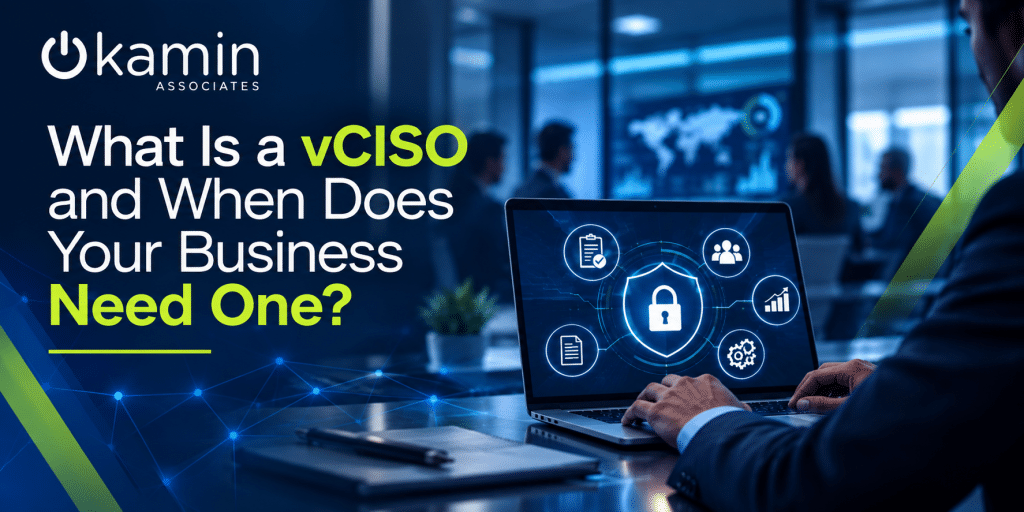
A vCISO gives organizations access to experienced cybersecurity leadership without requiring them to build a full executive security position internally. For growing businesses, this can provide the strategic direction needed to connect cybersecurity, compliance, technology, and business goals.
What Is a vCISO?
A vCISO is an outsourced cybersecurity professional who provides many of the strategic responsibilities traditionally handled by an internal CISO.
Rather than focusing only on individual security tools or technical problems, a vCISO looks at cybersecurity from an organizational perspective. The goal is to understand the company’s risks, determine where improvements are needed, and develop a practical security strategy.
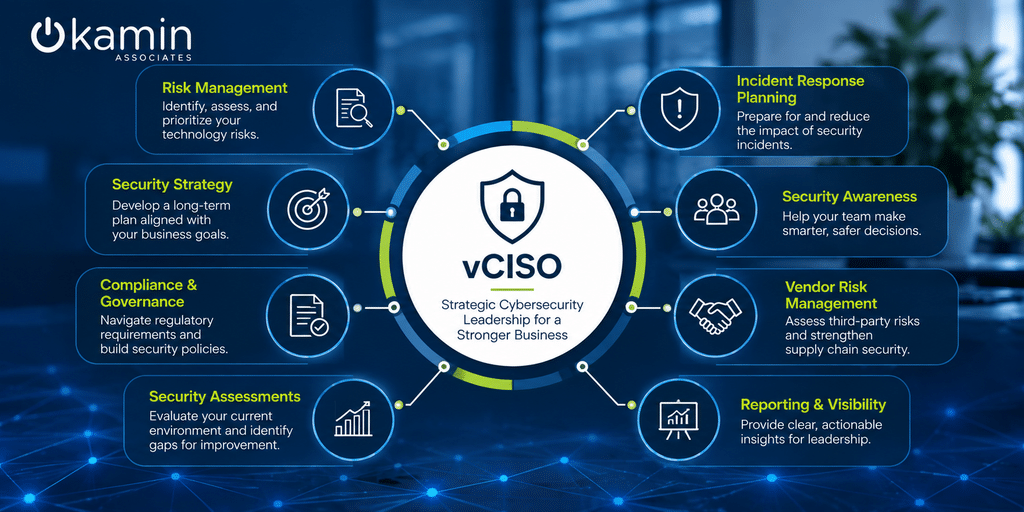
Depending on the organization’s needs, this may involve:
- Cybersecurity risk management
- Security policies and governance
- Compliance planning
- Security assessments
- Incident response planning
- Cybersecurity budgeting
- Employee security awareness
- Vendor risk management
- Security reporting
- Long-term cybersecurity planning
Kamin Associates includes Virtual CISO services within its Compliance & Governance offering, helping businesses strengthen oversight while developing policies, documentation, reporting, and compliance strategies.
Explore Kamin Associates’ Managed IT Solutions
vCISO vs. Traditional IT Support
IT support and cybersecurity leadership are closely connected, but they are not the same thing.
Traditional IT support typically concentrates on keeping technology functioning properly. That can include maintaining systems, supporting employees, managing networks, deploying updates, resolving technical issues, and monitoring infrastructure.
A vCISO takes a broader view.
Instead of asking only whether technology is working, a vCISO considers questions such as:
- What are the organization’s biggest cybersecurity risks?
- Which security investments should be prioritized?
- Are policies keeping pace with changes in the business?
- Does the company have an effective incident response plan?
- Are security practices aligned with compliance requirements?
- How should cybersecurity evolve as the company grows?
This strategic layer can complement the day-to-day technical work performed through managed IT services.
The combination can be particularly valuable because cybersecurity strategy and IT operations should support one another. A security policy has limited value if it is not properly implemented, while security technology can fall short when there is no larger strategy guiding how it is used.
vCISO vs. a Full-Time CISO
Larger organizations may have enough cybersecurity complexity to justify employing a full-time CISO. For many SMBs, however, that may be more leadership capacity than the organization currently requires.
A vCISO provides an alternative.
Businesses can gain access to cybersecurity expertise and strategic guidance based on their needs without creating another full-time executive position.
This model can make sense for an organization that needs help developing security policies, preparing for compliance requirements, prioritizing cybersecurity investments, or evaluating risk but does not require a CISO working internally every day.
The decision should ultimately depend on the company’s size, risk profile, industry, regulatory responsibilities, technology environment, and growth plans.
6 Signs Your Business May Need vCISO Services
Not every company reaches the need for cybersecurity leadership at the same point. However, several situations can indicate that it is time to consider additional strategic support.
1. Cybersecurity Decisions Are Becoming More Complicated
A firewall, antivirus platform, and backups are no longer the entirety of business cybersecurity.
Organizations may now manage cloud platforms, remote employees, mobile devices, third-party applications, multiple locations, and large amounts of sensitive information.
As the technology environment expands, understanding the relationships between those systems becomes increasingly important.
A vCISO can help establish priorities so cybersecurity investments address meaningful business risks instead of simply adding more tools.
2. You Have Compliance Requirements
Organizations in regulated industries may have specific requirements concerning how information is accessed, protected, stored, monitored, and documented.
Cybersecurity and compliance therefore need to work together.
A vCISO can help leadership understand applicable requirements, evaluate current practices, identify gaps, develop policies, and establish a plan for addressing deficiencies.
Kamin explores this relationship further in How to Build a Cybersecurity Strategy That Meets Compliance Requirements.
3. No One Owns the Cybersecurity Strategy
One of the clearest warning signs is uncertainty about who is responsible for cybersecurity.
IT employees may manage technology. Executives may approve budgets. Individual departments may manage applications or vendors. But nobody has responsibility for bringing those pieces together into a consistent cybersecurity program.
A vCISO can provide that strategic ownership by establishing objectives, identifying priorities, and helping leadership understand how cybersecurity decisions affect the business.
4. You Don’t Have a Clear Picture of Your Cyber Risk
Businesses cannot prioritize cybersecurity effectively if they do not understand their vulnerabilities.
That is why security leadership frequently begins with an assessment.
A network vulnerability scan can help uncover potential weaknesses within the technology environment, while a broader risk assessment considers how vulnerabilities could affect business operations.
Kamin’s article, Why Cybersecurity Risk Assessments Should Be Part of Every Business Growth Plan, explains how expanding users, devices, applications, vendors, and data can introduce additional security risks.
A vCISO can take assessment findings a step further by helping turn them into priorities and a longer-term cybersecurity roadmap.
5. Your Business Is Growing
Growth often changes an organization’s technology risk.
Hiring employees means creating more accounts and devices. Opening another office introduces additional infrastructure and connectivity requirements. Adding software can create new integrations and data flows. Working with additional vendors may introduce third-party risk.
Cybersecurity therefore needs to scale alongside the business.
Instead of addressing each new risk individually after it appears, vCISO services can help organizations consider security during the planning process.
This makes cybersecurity part of the growth strategy rather than something addressed only after problems occur.
6. Leadership Needs Better Cybersecurity Visibility
Executives do not necessarily need to understand every technical security alert, but they do need enough information to make informed decisions.
Which risks are most important? What needs immediate attention? Where should the organization invest? Are security controls improving? What happens if a major system becomes unavailable?
A vCISO can help translate technical cybersecurity information into business context.
That visibility can make conversations about budgets, technology investments, compliance, insurance requirements, and operational risk much more productive.
What Does a Strong vCISO Strategy Look Like?
Effective vCISO services should not begin with purchasing more technology.
They should begin with understanding the business.
That means evaluating the organization’s current technology environment, sensitive information, business objectives, compliance responsibilities, existing security controls, and risk tolerance.
From there, the organization can develop a cybersecurity roadmap that prioritizes improvements according to risk and business impact.
The technical components may include measures such as endpoint protection, access controls, backups, monitoring, network security, vulnerability management, and employee awareness.
Kamin’s IT Security Services address many of these technical areas, including network, endpoint, data, application, and cloud security.
The strategic component determines how those measures work together and where future investments should be made.
Cybersecurity Leadership Without Building an Internal Security Department
Small and midsize businesses face many of the same cybersecurity concerns as larger organizations, but they rarely have the same internal resources.
That does not mean cybersecurity leadership has to be absent.
Virtual CISO services can provide experienced strategic guidance while allowing businesses to scale their cybersecurity programs according to their actual needs. Combined with reliable IT support, security assessments, monitoring, policies, and technical safeguards, that leadership can help create a more organized approach to managing risk.
Kamin Associates helps businesses connect cybersecurity strategy with the technology supporting their daily operations. From Compliance & Governance and vCISO services to managed IT, cybersecurity, infrastructure, and vulnerability assessments, organizations can build a security program around their specific risks and business priorities.
If your organization has outgrown an informal approach to cybersecurity but is not ready to build an internal security leadership team, a vCISO may be the next step.
Contact Kamin Associates to discuss your cybersecurity priorities and determine how virtual CISO services can support your business.