
Business phone systems play an important role in customer service, employee communication, and daily operations. However, many companies continue relying on outdated equipment and traditional phone lines long after those systems have become difficult to maintain or too limited for their needs.
Modern business VoIP phone systems offer an alternative to traditional office phones, providing greater flexibility, scalability, and communication features without requiring businesses to maintain complex onsite telephone infrastructure.
For businesses in San Antonio and throughout South Texas, recognizing when to upgrade can help prevent communication problems, reduce unnecessary expenses, and support future growth.
Here are seven signs that your current business phone system may be ready for replacement.
1. Your Business Phone System Requires Frequent Repairs
Occasional technical problems can happen with any communication system. However, recurring phone outages, malfunctioning extensions, and unreliable equipment may indicate that your existing system is approaching the end of its useful life.
Older private branch exchange (PBX) systems often depend on specialized hardware that becomes increasingly difficult to repair or replace.
Common warning signs include:
- Frequent dropped calls or connection problems
- Phone extensions that stop working unexpectedly
- Difficulty finding replacement equipment
- Increasing maintenance expenses
- Limited technical support for older hardware
When repairs become routine, maintaining the existing system may no longer be the most practical option.
Modern VoIP phone services can reduce dependence on expensive onsite telephone equipment while providing businesses with more flexible communication options.
2. Employees Cannot Easily Make Business Calls Outside the Office
Traditional business phone systems were generally designed around employees working at assigned desks in a central office.
Today, many organizations operate across multiple locations or have employees who regularly work remotely, travel, or visit customer sites.
If employees must be physically present to answer their business extensions, your phone system may be limiting productivity.
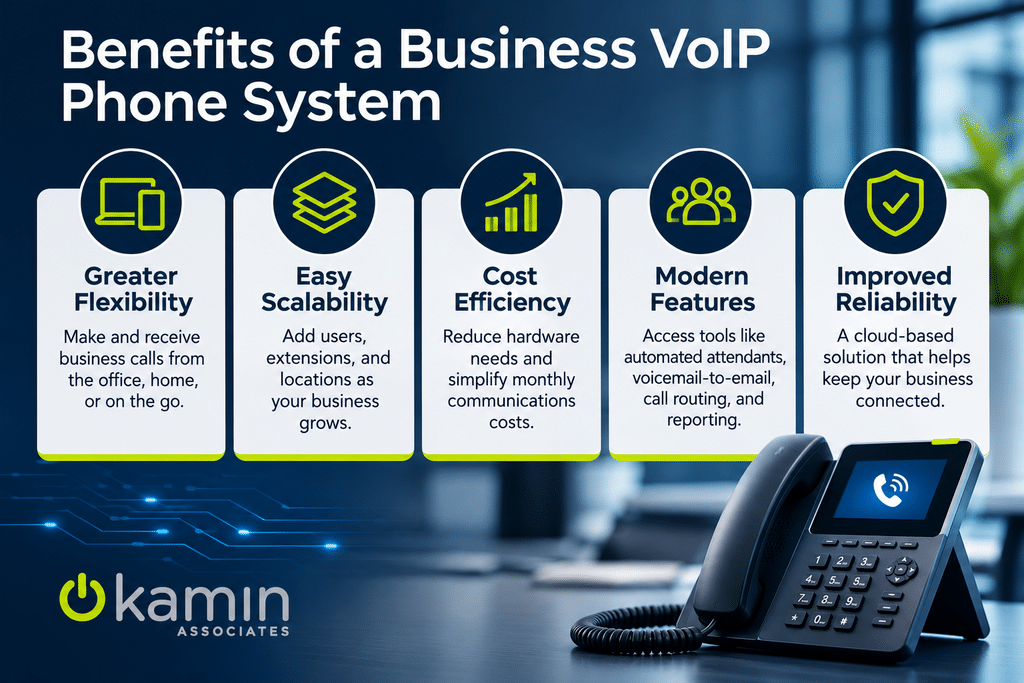
Cloud-based VoIP phone systems can allow employees to make and receive business calls using compatible desk phones, computers, or mobile applications.
Depending on the system, employees may also access:
- Business extensions from multiple devices
- Call forwarding and routing
- Voicemail-to-email
- Shared company phone numbers
- Remote communication features
These capabilities help employees remain accessible without relying exclusively on a physical office telephone.
Businesses considering this transition can learn more about the underlying technology in Kamin Associates’ article, What Is VoIP and How Does It Work?.
3. Your Monthly Phone Bills Keep Increasing
Traditional phone systems can involve multiple expenses beyond the monthly telephone service bill.
Businesses may pay for individual phone lines, long-distance calling, equipment maintenance, replacement hardware, and additional features.
As the organization grows, these expenses can become increasingly difficult to manage.
Business VoIP phone systems often use subscription-based pricing, allowing companies to select services based on their communication requirements.
Potential financial advantages include reduced hardware expenses, simplified service management, and more predictable monthly costs.
However, VoIP is not automatically less expensive for every business.
Organizations should compare their existing telephone expenses against the total cost of a new solution, including internet connectivity, equipment, subscriptions, installation, and support.
A thorough evaluation helps determine whether upgrading would provide meaningful long-term value.
4. Adding New Phone Lines or Extensions Is Complicated
Business growth frequently creates new communication requirements.
Hiring employees, opening additional offices, or expanding departments may require more phone numbers, extensions, and calling capacity.
With older telephone systems, these changes can involve purchasing additional hardware, installing physical lines, or scheduling specialized technical work.
Modern business VoIP phone systems are generally easier to scale.
Depending on the provider and configuration, administrators can add users, adjust extensions, and update call routing without making extensive changes to physical telephone infrastructure.
This flexibility is especially valuable for growing organizations that need their technology to adapt alongside their operations.
As Kamin Associates explains in Preparing Your Network for Business Expansion, evaluating infrastructure capacity before business growth helps organizations avoid performance limitations and unnecessary disruptions.
The same principle applies to business communication systems.
5. Your Phone System Lacks Modern Communication Features
Business communication involves more than making and receiving calls.
Customers expect to reach the appropriate department, employees need efficient ways to manage messages, and managers benefit from visibility into communication activity.
Older office phone systems may offer limited functionality or require expensive upgrades to support modern features.
Depending on the provider and service plan, business VoIP solutions may include:
- Automated attendants that direct incoming calls
- Voicemail delivered to employee email accounts
- Call forwarding and simultaneous ringing
- Custom business hours and call routing
- Conference calling
- Mobile and desktop calling applications
- Call reporting and analytics
These features can improve how businesses manage incoming calls and coordinate communication across departments.
For example, a professional services company may use an automated attendant to route callers to accounting, customer support, or administration.
A business with field employees may use mobile calling capabilities to keep staff connected while away from their desks.
The right features depend on how the organization operates and communicates with customers.
6. Call Quality and Reliability Are Affecting Customer Service
Poor call quality can create frustration for employees and customers.
Delayed audio, dropped calls, and inconsistent connections make conversations more difficult and can interrupt important business activities.
However, these problems do not always mean the phone system itself needs replacement.
With VoIP technology, call quality depends partly on the performance and configuration of the underlying network.
Insufficient bandwidth, network congestion, faulty equipment, or improper traffic prioritization can contribute to communication problems.
Before replacing a phone system, businesses should evaluate their network infrastructure to identify the source of recurring issues.
Kamin Associates discusses related warning signs in Business Network Upgrade: 7 Signs It’s Time to Modernize Your IT Infrastructure.
Businesses implementing VoIP should also consider network monitoring, appropriate bandwidth, and backup connectivity options.
A properly designed communication environment helps reduce avoidable disruptions, although no phone system can guarantee uninterrupted service.
7. Your Existing Phone System Cannot Support Future Business Needs
A phone system that meets today’s requirements may not be suitable for tomorrow’s operations.
Businesses planning to expand, relocate, introduce hybrid work arrangements, or modernize their technology should consider whether their existing telephone infrastructure can accommodate those changes.
For example, an organization opening a second office may want employees at both locations to use a consistent business phone system.
A company adopting new customer relationship management software may want communication features that integrate with its business applications.
These requirements can be difficult or expensive to support with outdated telephone equipment.
Modern VoIP platforms can provide greater flexibility, although available integrations and capabilities vary by provider.
Before making changes, organizations should evaluate their current communication requirements, anticipated growth, and existing technology environment.
A structured approach can also reduce migration risks. Kamin Associates outlines useful planning principles in What Is IT Change Management?, including documenting existing systems, assessing potential disruptions, and validating changes after implementation.
What Should Businesses Consider Before Switching to VoIP?
Replacing an office phone system requires more than choosing a new provider.
Businesses should evaluate several factors before beginning the transition.
- Internet and network readiness: Reliable connectivity and sufficient network capacity are important for maintaining consistent VoIP performance.
- Existing phone numbers: Confirm that important business numbers can be transferred to the new provider before canceling existing services.
- Equipment requirements: Determine whether employees need physical desk phones or can use computer and mobile applications.
- Security: Review encryption, account protection, access controls, and provider security practices.
- Emergency calling: Verify emergency calling capabilities, including location information for employees working at different sites.
- Implementation planning: Establish a migration schedule, test call routing, and provide employees with appropriate training.
Working with an experienced IT provider can help businesses identify potential complications before making the switch.
Upgrade Your Business Phone System With Kamin Associates
An outdated phone system can create unnecessary expenses, limit employee flexibility, and make business communication more difficult than it needs to be.
Modern business VoIP phone systems offer organizations an opportunity to simplify telephone management, improve scalability, and access communication features that support changing business requirements.
Kamin Associates provides business VoIP phone services for organizations in San Antonio and surrounding areas, with scalable solutions and ongoing support.
Whether your business is replacing an aging telephone system, expanding to additional locations, or evaluating more flexible communication options, Kamin Associates can help you explore a solution suited to your operations.
Contact Kamin Associates to discuss your current phone system and learn how modern VoIP technology can support your business.